
A recent Eurostat map shows that there is no single European AI story.
Norway leads at 56% adoption. Romania is at 18%. Germany, Europe’s largest economy, is at just 32%, below Spain, France, and Portugal. The gap between the highest and lowest adopters is wider than many leadership teams may realize.
For leaders running organizations across multiple European markets, this is a real challenge. When adoption varies this much from country to country, you cannot roll out one AI transformation playbook and expect it to land everywhere.
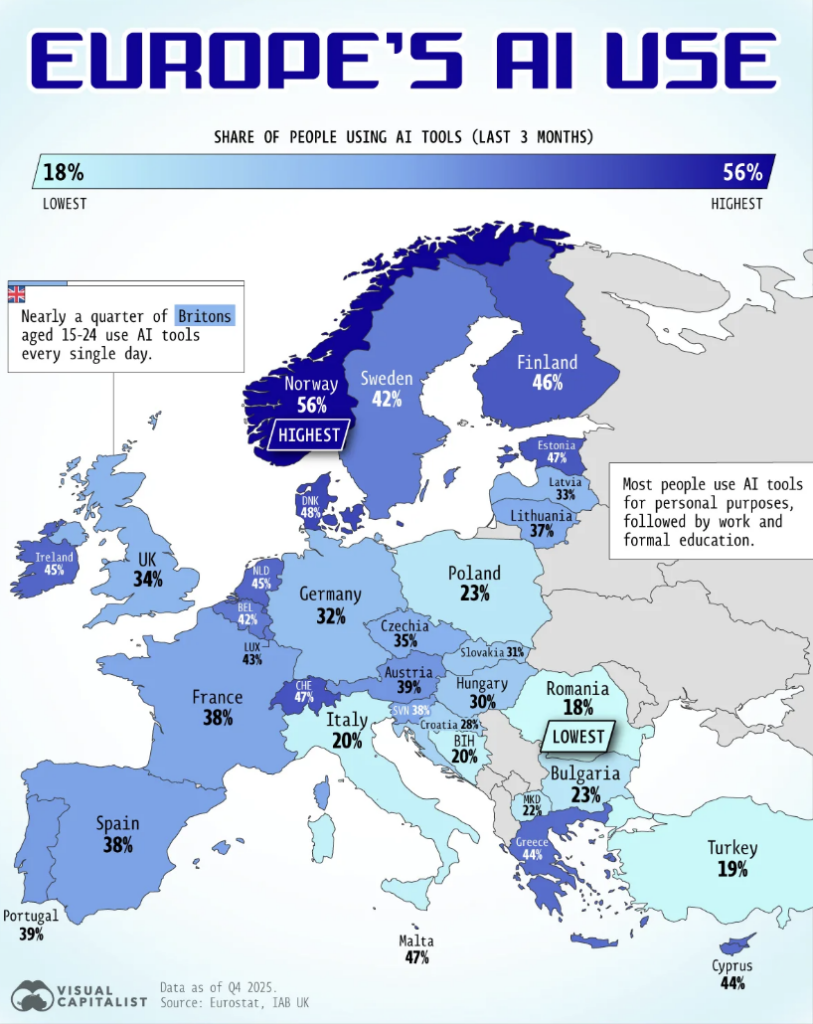
Image Credit: Visual Capitalist Source Data: Eurostat / Graphite
Multi-Speed Transformation Demands Localized Leadership
At a recent IESE Business School session, Professor Evgeny Kaganer framed the challenge simply. AI is extremely good at doing work: executing tasks, generating outputs, and processing information. But two decisions remain deeply human: deciding what needs to be done in the first place, and evaluating whether the output is actually good.
As Kaganer said, “It’s the doing of the tasks, the performing of the tasks, that’s what AI is getting extremely good at. But the decision about what to work on… and then ultimately what good looks like, that’s really where judgment resides.”
This question of judgment sits at the center of every AI transformation. As AI takes on more of the work itself, leaders need to decide where human judgment still matters most.
Across Europe, that question looks different depending on the market.
In Norway or Finland, where nearly half the population already uses AI tools, this judgment question is already urgent. In markets with higher AI adoption, the competitive advantage is no longer just whether people are using AI. It is whether leaders know what to delegate, what to protect, and where human judgment creates the most value.
In Romania or Italy, at 18% and 20% respectively, the foundational work of building fluency and trust may still need to happen. The judgment conversation is coming, but the readiness gap has to close first.
This means a leader overseeing operations in both Stockholm and Bucharest is managing two different transformations at once. The starting points are different. The cultural attitudes toward technology may be different. The labor market dynamics are different. The level of change readiness is different, too.
“The more technology we have in the society, the more humanism has to be developed.”
– Juvencio Maeztu, CEO of Ingka Group (IKEA)
As a result, the conversation cannot stay focused on technology rollout alone but has to move into change leadership, too.
A single AI operating model will not work for a workforce that spans a 38-percentage-point adoption gap. Leaders need to think carefully about the order in which they build capability, the pace at which they redesign workflows, and the extent to which employees in each market see AI as an opportunity or a threat.
Those differences shape everything from training design to communication strategy.
Juvencio Maeztu, President and CEO of Ingka Group, IKEA, put it simply at the same session: “The more technology we have in society, the more humanism has to be developed.”
It is a simple but powerful point. The map shows us a technology adoption gap, but the real gap is in leadership development. Leaders need to make AI adoption human-centered, context-sensitive, and locally grounded. The human side of leadership matters more now than ever before.
Companies that treat this as one corporate rollout will likely stall, while the ones that build change strategies market by market, meeting people where they are, will move faster.
Europe’s AI story is not just about who has a higher rate of adoption. It is about whether leaders can navigate transformation at multiple speeds, in multiple contexts, at the same time. The good news is that this is not a new problem. It is a familiar one. It is a leadership one.
At Kotter, we help organizations lead change that actually sticks — not through one-size-fits-all rollouts, but by building the leadership capability and urgency needed to move at the speed of your people. If your organization is navigating AI transformation across multiple markets, teams, or readiness levels, let’s talk.