
For a while, Burger King became the fast-food restaurant you went to when…well, there weren’t many other options on the road. The brand that had spent decades telling us to “Have It Your Way” left us with experiences that varied greatly depending on location and owner, leaving a noticeable gap between its promise and the experience customers were actually having. The brand knew it had a problem. But instead of simply launching another ad campaign telling us Burger King had changed, leadership did something more important: they listened, they acted.
This lesson in change management has actually been several years in the making. In 2022, Burger King launched “Reclaim the Flame,” a multi-year plan intended to accelerate growth in the United States. The company committed $400 million toward the effort, including advertising and digital investments and improvements in restaurant technology, kitchen equipment, building enhancements, remodels, and relocations. Franchises representing more than 93% of U.S. restaurants endorsed the plan and agreed to co-invest in increased advertising (Burger King, 2022).
Four years later, Burger King isn’t just telling us it wants to “Reclaim the Flame.” Under U.S. and Canada President Tom Curtis, it is increasingly giving customers, franchisees, and employees tangible evidence of what reclaiming it might actually look like. What we can see from Tom Curtis is that he’s already well on his way to following these steps and making drastic changes at Burger King not just for their bottom line, but for the experience for the customers. This is change leadership in action.
To reflect on these changes made, and make it possible for you to replicate the experience, let’s reduce this major project into simpler terms. Let’s turn to Rogers Law of Diffusion. Rogers’ Diffusion curve divides a population into innovators, early adopters, early majority, late majority, and laggards. The model has been referenced by technology companies for years because it helps explain something leaders frequently experience during transformation: people do not adopt something new at the same time, for the same reasons, or with the same amount of evidence. In Burger King’s case, I see three things beginning to emerge: the challenge is becoming clear (why), wins are becoming visible (proof), and leadership commitment is becoming increasingly difficult to miss (commitment).
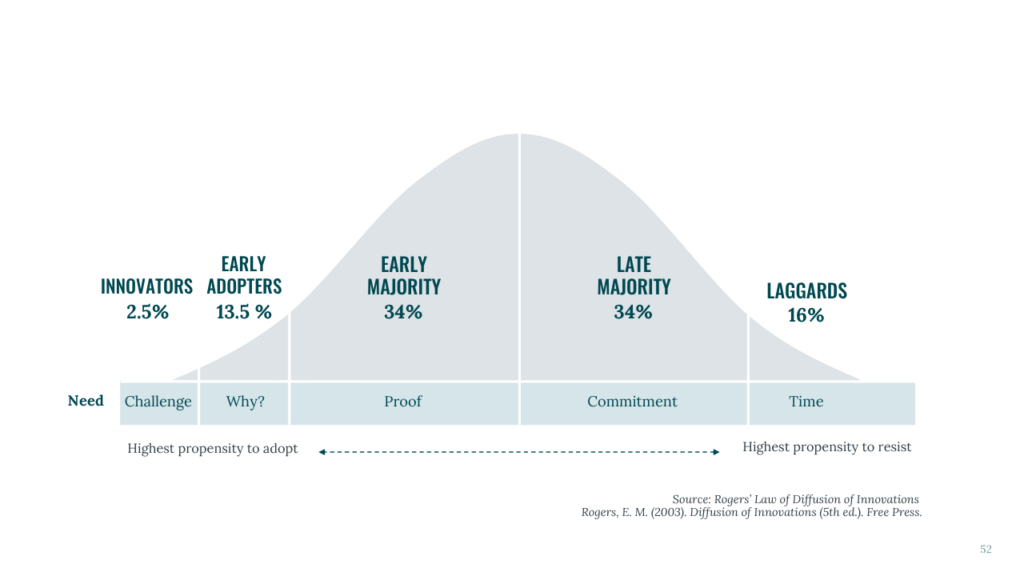
1) Addressing the Challenge and Why: Identify and Own the Problem
Before you can convince people that something new is worth adopting, they have to understand why the status quo isn’t good enough. Burger King’s original Reclaim the Flame announcement was surprisingly direct about that challenge. The company described the need to modernize its restaurant portfolio, improve restaurant-level execution and profitability, enhance the guest experience, and ultimately attract traffic back to the brand (Burger King, 2022). The solution wasn’t positioned as a single marketing problem because, frankly, the problem wasn’t simply marketing.
By 2026, that willingness to confront the problem became even more visible. In their 2026 Super Bowl ad, Curtis ended the ad by listing a phone number for customers to call and let him know what needed to be fixed about the brand. Curtis quite literally gave customers access to him, inviting them to call or text with feedback about their Burger King experiences. Thousands responded, providing feedback about food, order accuracy, consistency, and service (Burger King, 2026). It’s one thing to commission customer research and read the findings in a conference room. It’s another to publicly say: I know we’re off the mark, tell me what isn’t working.
From a change perspective, that matters. Before leaders can create excitement about where an organization is going, they need enough honesty about where it is today. They need to pause and take stock. No sugarcoating, no gaslighting. People are much less likely to believe a transformation story when leadership’s version of the current state doesn’t resemble the one everyone else is experiencing.
2) Addressing Proof: Make the Change Visible
Of course, acknowledging the problem only gets you so far. At some point, people need evidence that something is actually different. Generating proof points is key to ain the attention and trust of the large group of early majority. The company has been creating proof points across the customer experience rather than relying on a single “we’ve changed” message. Burger King upgraded the Whopper based on customer feedback, making changes to ingredients, preparation, and packaging (Burger King, 2026). It launched a campaign that moved the King out of the spotlight and declared its customers the new kings of the brand (Burger King, 2026).
Then in July, Burger King introduced the “Your Way Champion,” a reimagined restaurant leadership role focused specifically on welcoming guests, checking order accuracy, and making problems right (Burger King, 2026d; Canham-Clyne, 2026).
The scale of the initial investment reinforced that point. Burger King was putting hundreds of millions of dollars behind changes to restaurants, technology, equipment, operations, digital capabilities, and marketing. In 2024, Restaurant Brands International announced additional investment intended to bring 85%–90% of U.S. Burger King restaurants to a modern image by 2028 (Restaurant Brands International, 2024).
In other words, Burger King wasn’t simply saying, We need customers to think differently about us. It was acknowledging, through its investment decisions, We need to operate differently if we want customers to think differently about us.
Perhaps most visibly, Burger King introduced the Whopper Guarantee: if your Whopper isn’t made correctly, they’ll remake it and give you your next Whopper free. On its own, a free hamburger isn’t a transformation strategy, but it is a signal.
Burger King is taking something customers identified as a problem—consistency—and attaching accountability to it. The company isn’t just telling customers that accuracy matters; it’s creating a consequence when it doesn’t happen, restoring trust from customers and pride in employees.
3) Addressing Commitment: Leadership Has to Step Up
The third piece is commitment, and Burger King’s leadership has increasingly made that visible as well. Curtis didn’t delegate listening to a customer-insights team, he attached himself personally to the feedback effort. After his visiaible role in the Super Bowl ad, he has spent time working inside Burger King restaurants. Additionally, the organization has used Royal Roundtables, franchisee engagement, guest surveys, and expanded field support to involve the people responsible for translating the strategy into the day-to-day restaurant experience.
Leadership has attached investment capital, deployed new operating changes, introduced new roles, and tied, publicly, its own credibility to the outcome. For anyone leading transformation, there is an important lesson in that distinction. Asking employees, operators, or customers to take a chance on something new inherently asks them to accept some risk. Leadership commitment helps reduce that perceived risk. If I can see leaders changing their own behavior, committing resources, and staying visibly involved after the initial announcement, I have more reason to believe this effort might be different from the ones that came before it. Through his works and actions, Curtis is demonstrating to all levels of the organization: I’m not simply asking you to change. I’m invested in this changing, too.
But Can Burger King Make the Change Stick?
That, of course, is still the question. There are early signs that the strategy is producing results. Burger King reported 8.5% U.S. comparable sales growth in the second quarter of 2026, exceeding analyst expectations, with executives pointing to momentum surrounding the revamped Whopper as one contributor (Reuters, 2026). But a strong quarter does not mean a transformation is complete, particularly for a brand trying to change perceptions built through years of inconsistent experiences.
As we teach and preach at Kotter, you can’t step off the gas when you see progress, you need to continue change efforts until the changes stick. Reclaiming the Flame did not happen when Burger King announced a transformation. It doesn’t even happen when its most enthusiastic customers notice the difference. It happens when the changes become consistent enough, visible enough, and credible enough that the much larger majority begins to reconsider what they believe about the brand.
Burger King isn’t the first restaurant company to confront this challenge. Domino’s famously built a turnaround around acknowledging that customers didn’t like its pizza, changing the product, opening up the experience, and then giving customers more visibility into the process. The lesson wasn’t that clever marketing could erase a bad experience. The marketing worked because it pointed toward changes customers could actually encounter. The same will ultimately be true for Burger King. The advertising may get someone back through the door, but the restaurant experience has to convince them to return.
You can’t communicate your way out of a bad experience. Eventually, people need to experience the change you’ve been promising. As someone that started their career in advertising, that’s the tough truth and the change-management lesson I keep coming back to: organizations can spend enormous amounts of time crafting the perfect transformation message, but people don’t change because leadership has found the perfect words or crafted a Clio-winning ad. They adopt when the change feels real, when they can see proof that something is changing, and when those leading the effort, asking them to change, demonstrate that they are committed to moving too.
That’s the change-management lesson.
Recognize the problem.
Put leadership behind solving it.
Create visible proof of change.
Then build the systems that make the new behavior stick.
So, has Burger King reclaimed its flame? Maybe not yet. But it has done something far more interesting than simply tell us that it has changed. It has started giving us reasons to believe it.
About the Author:
Leslie Zemnick, Kotter Principal, is based in New York City and Washington, D.C.
Sources:
Burger King. (2022, September 9). Burger King announces “Reclaim the Flame” plan to accelerate growth in the U.S. Burger King Newsroom.
(https://news.bk.com/blog-posts/burger-king-r-announces-reclaim-the-flame-plan-to-accelerate-growth-in-the-u-s)
Burger King. (2026, February 17). Burger King puts its president on the line, giving guests direct access to share feedback. Burger King Newsroom. (https://news.bk.com/blog-posts/burger-king-r-puts-its-president-on-the-line-giving-guests-direct-access-to-share-feedback)
Burger King. (2026, February 26). Burger King elevates its most iconic product, the Whopper! Burger King Newsroom. (https://news.bk.com/blog-posts/burger-king-elevates-its-most-iconic-product-the-whopper-r)
Burger King. (2026, March 16). Burger King crowns its guests king in new ad campaign. Burger King Newsroom. (https://news.bk.com/blog-posts/burger-king-crowns-its-guests-king-in-new-ad-campaign)
Burger King. (2026, July 20). Burger King continues turning guest feedback into action with the “Your Way Champion” and Whopper Guarantee. Burger King Newsroom. (https://news.bk.com/blog-posts/burger-king-continues-turning-guest-feedback-into-action-with-the-your-way-champion-and-whopper-guarantee)
Canham-Clyne, A. (2026, July 20). Burger King reworks manager role to support guest experience. Restaurant Dive. (https://www.restaurantdive.com/news/burger-king-customer-feedback-your-way-champion-manager-role/825547/)
Allrecipes. (2026, July 23). Burger King just announced a major change—and it could get you free Whoppers. (https://www.allrecipes.com/burger-king-whopper-guarantee-your-way-champion-12024046)
Restaurant Brands International Inc. (2024). Burger King announces additional investment to achieve 85%–90% Modern Image in U.S. Restaurants by 2028. (https://www.rbi.com/English/news/news-details/2024/Burger-King-Announces-Additional-Investment-to-Achieve-85-90-Modern-Image-in-U.S.-Restaurants-by-2028/default.aspx?utm_source=chatgpt.com)
Reuters. (2026, August 6). Burger King’s U.S. strength helps Restaurant Brands top quarterly same-store sales estimates. (https://www.reuters.com/world/americas/restaurant-brands-beats-quarterly-same-store-sales-estimates-burger-king-2026-08-06/)
Business Insider. (2026, August 14). Burger King revamped its playbook. It’s working. (https://www.businessinsider.com/burger-king-mcdonalds-fast-food-burger-whopper-bi-today-newsletter-2026-8)